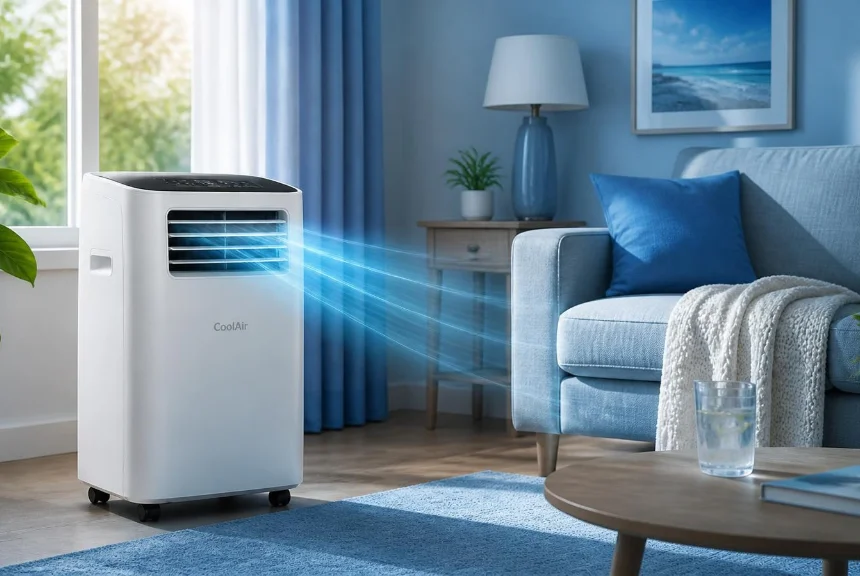
A small portable air conditioner can cool a bedroom, home office, or compact flat without permanent installation. The right model must still match your room, window, noise tolerance, and electricity budget. Size alone tells you surprisingly little about how comfortable the unit will be.
For most UK bedrooms and small offices, a compact 7,000–8,000 BTU portable AC is the practical starting point. Choose by room size, noise, window fit, and rated input, not cabinet width alone. Every compressor model needs its hot exhaust air vented outside for effective cooling.
Small Portable AC at a Glance
| Buying factor | Practical UK guidance |
|---|---|
| Cooling capacity | Around 7,000–8,000 BTU suits many smaller rooms |
| Typical room use | Bedrooms, studies, box rooms, and compact home offices |
| Window requirement | Compressor units require an exhaust route outside |
| Noise | Check published low and maximum figures before bedroom use |
| Rated input | Many compact models draw roughly 780–1,005W |
| Portability | Wheels help, but many units still weigh around 20–24kg |
| Useful extras | Timer, dehumidifying mode, remote, sleep mode, Wi-Fi |
| Key mistake | Choosing by cabinet dimensions without checking cooling demand |
Key Takeaways
- A smaller cabinet does not automatically mean lower noise or lower electricity use.
- Around 7,000 BTU can suit a closed bedroom measuring roughly 15 m².
- Larger, sunnier, poorly insulated rooms may need more cooling capacity.
- An exhaust hose must send hot air outside during cooling.
- Window sealing can affect performance as much as headline specifications.
- Check weight if you plan to move the unit upstairs frequently.
- Compare rated power before assuming a lower-BTU model costs less to run.
What Counts as a Small Portable Air Conditioner?
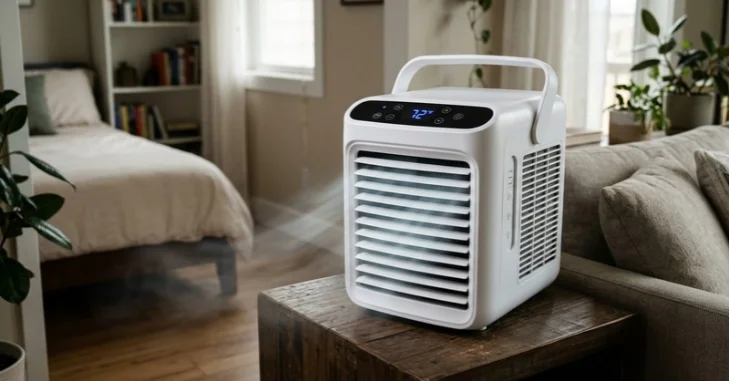
Small Portable Air Conditioner compact models normally combine a compressor, heat exchanger, fan, and controls inside one wheeled cabinet. That hardware places practical limits on how tiny genuine air conditioning can become. Desktop water coolers are therefore not equivalent to compressor-based AC.
One useful benchmark comes from the 7,000 BTU VonHaus model. It measures 67cm high, 30cm wide, and 29cm deep. The manufacturer recommends it for spaces up to 15 m².
The AKAI ACP730K provides another compact reference point. It measures 31.6cm wide, 67.8cm high, and 32.9cm deep. Appliances Direct gives it a 7,000 BTU rating and guidance up to 20 m².
If you need a broader overview first, Scrollex also has a guide to portable air conditioners, features, prices, and maintenance. That article covers the wider category. This guide focuses specifically on compact units and smaller UK rooms.
Compact Models Worth Comparing in the UK
No single unit suits every small room. Bedroom buyers may prioritise noise, while renters may care more about window-kit flexibility. The table below compares three genuine compact options using published specifications.
| Model | Cooling | Published room guidance | Noise | Size | Best suited to |
|---|---|---|---|---|---|
| VonHaus 7000 BTU | 7,000 BTU | Up to 15m² | 52–65dB | 67 × 30 × 29cm | Small bedrooms and offices |
| AKAI ACP730K | 7,000 BTU | Up to 20m² | Check current listing | 67.8 × 31.6 × 32.9cm | Slimline installations |
| MeacoCool MC Series Pro 8000 CH | 8,000 BTU | 16–26m² | 52–54dB | 70.1 × 34.1 × 33.5cm | Larger bedrooms and flexible window setups |
The VonHaus 7000 BTU is the strongest compact choice for limited floor space among these examples. Its 30cm width and 29cm depth make placement easier. The main drawback is a published maximum noise figure of 65dB.
The AKAI is another sensible option where a narrow body matters. Its rated input is 800W, and the package includes a 1.5-metre exhaust hose. The manufacturer information also confirms that external venting remains necessary.
The MeacoCool costs more but offers extra flexibility and lower published sound figures. It includes heating, Wi-Fi control, dehumidifying, and two window-kit options. Its 24kg weight makes it less convenient for regular stair carrying.
Pros and Cons
VonHaus 7000 BTU
- Pros: narrow cabinet, 20kg weight, Class A rating, two-year warranty.
- Pros: manufacturer guidance covers rooms up to 15 m².
- Cons: published sound reaches 65dB at the upper end.
AKAI ACP730K
- Pros: slim dimensions, 800W rated input, 24-hour timer.
- Pros: exhaust hose and window kit are supplied.
- Cons: suitability depends heavily on your window arrangement.
MeacoCool MC Series Pro 8000 CH
- Pros: flexible window kits, heating, Wi-Fi, and dehumidifying modes.
- Pros: published noise range is 52–54dB.
- Cons: its 24kg weight reduces true room-to-room portability.
How Much Cooling Capacity Does a Small Room Need?
Cooling capacity is normally expressed in British Thermal Units, or BTU. Higher BTU figures indicate greater cooling capacity. Bigger is not automatically better for every compact bedroom.
A 7,000 BTU unit is a sensible starting point for many smaller closed rooms. VonHaus rates its current model for spaces up to 15m². Its specification provides a useful reference rather than a universal sizing rule.
An 8,000 BTU model can give extra headroom in a larger bedroom or warmer home office. Meaco recommends 16–26 m² for its 8,000 BTU model. Actual demand still changes with glazing, insulation, ceiling height, occupants, and direct sunshine.
Avoid buying solely from the largest room-size claim you see online. Manufacturers may use different test conditions and measurement methods. Compare room guidance alongside rated capacity and your room’s real conditions.
Why the Exhaust Hose Matters So Much
A compressor-based unit moves heat rather than making it disappear. The exhaust hose carries collected heat away from the room. Leaving that heat indoors defeats much of the cooling process.
Keep the hose reasonably short and avoid unnecessary bends where your manual permits. Seal gaps around the window attachment carefully. Warm outside air entering through large gaps makes the compressor work harder.
This requirement also separates true AC from many inexpensive personal coolers. Scrollex’s UK air cooler guide explains the alternative technology. Evaporative coolers use water and airflow rather than a refrigeration cycle.
How Noisy Are Compact Portable AC Units?
Noise deserves special attention when the appliance will sit beside your bed. A compressor and fan operate inside the room throughout cooling. That makes portable systems more noticeable than systems with outdoor compressors.
Published figures vary considerably between products and operating modes. VonHaus states 52–65dB for its 7,000 BTU model. Meaco publishes 52–54dB for its 8,000 BTU model.
Published decibel figures still cannot predict your personal sleep tolerance. Independent testing found the Meaco model effective but uncomfortable for the reviewer overnight. Pre-cooling the bedroom before sleep can therefore be a practical alternative.
How Much Does a Compact Unit Cost to Run?
Rated input provides a useful way to estimate electricity costs. Multiply kilowatts by your electricity unit rate and hours used. Your actual bill can differ because compressors may cycle after reaching the target temperature.
Ofgem’s average electricity rate for direct-debit price-cap customers is 26.32p per kWh from October through December 2026. An 800W appliance would cost roughly 21p per hour at continuous rated input. A 1,005W appliance would be about 26p per hour under the same assumption.
Your tariff, temperature setting, insulation, weather, and compressor cycling change real consumption. Treat those figures as simple comparison estimates rather than guaranteed bills. Buyers comparing alternatives can also read Scrollex’s guide to fan running costs.
Portable AC or Air Cooler for a Small UK Room?
Choose a portable AC when you need genuine refrigerated cooling and can vent outdoors. It can reduce room temperature rather than creating airflow alone. The trade-offs are higher power use, compressor noise, and a bulky exhaust hose.
An air cooler can suit people wanting cheaper personal cooling without refrigeration. These devices depend on water evaporation and require suitable airflow. Their performance differs significantly from compressor cooling.
A standard fan remains the simplest option during milder weather. It uses far less electricity but does not lower the room’s actual air temperature. Your best choice therefore depends on heat levels and the result you expect.
Features That Matter More Than Smart Controls
Start with the physical details before comparing apps and remote controls. Measure the available floor area beside your intended window. Then check how the exhaust kit connects to your particular window style.
Next, check weight and handles if you expect regular movement. Twenty kilograms may roll easily across one floor but becomes awkward on stairs. A product labelled portable is not necessarily light enough for frequent carrying.
Dehumidifying mode can add useful value outside the hottest weeks. It may help manage excess indoor moisture when used according to the manufacturer’s instructions. Scrollex’s dehumidifier guide for UK homes explains dedicated moisture-control options in more detail.
Our Verdict: Which Compact Type Should You Choose?
Choose around 7,000 BTU when space is tight, and your closed room is relatively small. The VonHaus example has an especially narrow footprint among the models compared here. Its higher maximum sound figure deserves consideration before bedroom use.
Move toward 8,000 BTU when the room is larger or gains more heat. The Meaco option also makes sense when flexible window fittings matter. Its added features come with a higher price and heavier cabinet.
Do not pay for cooling capacity your room cannot use effectively. First, measure the room and identify a safe exhaust route. Then compare noise, rated power, dimensions, weight, warranty, and current stock.
Before You Buy
Measure your room, floor space, and window before choosing a unit. Compare verified specifications rather than relying on words such as mini or compact. These checks can prevent an expensive mismatch during the next UK hot spell.
For wider model research, continue with Scrollex’s broader portable cooling guide before purchasing. Check current retailer stock because summer availability can change quickly. Buy the smallest model that can comfortably meet your room’s genuine cooling requirement.
Frequently Asked Questions
Is a small portable air conditioner good for a bedroom?
Yes, when its cooling capacity matches the bedroom and hot air can vent outside. Noise should be checked before buying for overnight use. Pre-cooling the room before bedtime can help noise-sensitive sleepers.
Does a portable AC need a window?
It needs an external route for hot exhaust air during cooling. A window is the easiest option in most homes. Some rooms may allow another suitable external opening approved by the manufacturer.
Is 7,000 BTU enough for a small room?
It can be enough for many compact, closed rooms. Current manufacturer examples give guidance around 15–20 m² for some 7,000 BTU models. Sunlight, insulation, glazing, and ceiling height can increase cooling demand.
Can I use one without the exhaust hose?
Not effectively when using a conventional compressor unit in cooling mode. The machine must remove collected heat from the room. Appliances Direct confirms this requirement for its AKAI compact model.
Are smaller models cheaper to run?
Not necessarily, because cabinet size and BTU do not determine electricity use alone. Compare the rated wattage shown in each specification. Your tariff and compressor operating time also affect the final cost.