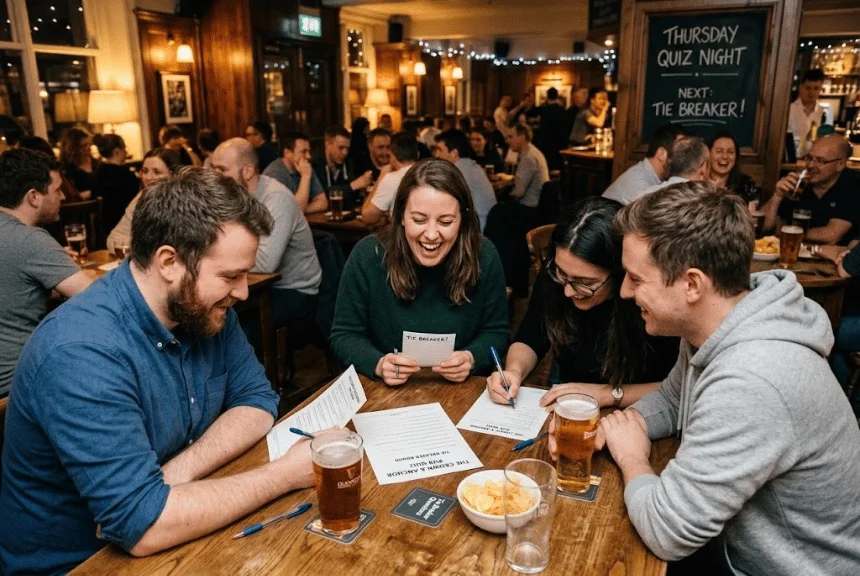
A close quiz can end with two teams sharing first place. Tie breaker questions give the host a quick and fair way to choose a winner. The best ones use numerical answers, so the nearest guess takes the prize.
Quick answer: A good quiz tie-breaker asks for a specific number that players are unlikely to know exactly. Each tied team writes down one guess. The team closest to the correct answer wins, whether their guess is above or below it. Keep at least two spare questions ready for another draw.
| Quick fact | Best approach |
|---|---|
| Ideal format | Numerical, nearest-wins question |
| Best for | Pub quizzes, family games, work events and school quizzes |
| How many to prepare | At least three |
| Winner | Team with the closest answer |
| Good subjects | UK facts, sport, entertainment, science and numbers |
| Avoid | Simple facts everyone knows exactly |
How Tie Breaker Questions Work
A quiz tie-breaker should separate teams without starting another full round. Numerical estimation works well because different teams usually produce different guesses. It also gives players a chance to reason instead of relying only on exact recall.
Ask every tied team to write its answer before revealing anything. Compare each guess with the correct figure, then calculate which answer is closest. If two guesses are equally close, use another prepared question.
UK quiz sites commonly use this nearest-wins format for pub quiz play-offs. Current examples also favour measurements, dates, distances and unusual statistics.
40 Tie Breaker Questions and Answers
These questions cover easy, medium, and harder subjects. Most have answers that players can estimate without knowing the exact figure. Hosts can mix categories or choose a question suited to their audience.
General Numbers and Everyday Knowledge
| # | Question | Answer |
|---|---|---|
| 1 | How many minutes are there in one week? | 10,080 |
| 2 | How many keys does a standard piano have? | 88 |
| 3 | How many squares are printed on a standard chessboard? | 64 |
| 4 | How many cards are in a standard deck without jokers? | 52 |
| 5 | How many centimetres are in one metre? | 100 |
| 6 | How many faces does a cube have? | 6 |
| 7 | How many sides does a dodecagon have? | 12 |
| 8 | How many degrees make a complete circle? | 360 |
These work best when you need a quick play-off. Some answers are easier than others, so choose according to your group. Save the simplest options for family or younger-player quizzes.
UK Tie-Breaker Questions
| # | Question | Answer |
|---|---|---|
| 9 | How high is Ben Nevis in metres? | 1,345 metres |
| 10 | In what year did the London Underground first open? | 1863 |
| 11 | Approximately how long is the M25 motorway? | 117 miles |
| 12 | What is Wembley Stadium’s seated capacity? | 90,000 |
| 13 | How many national parks are there across the UK? | 15 |
| 14 | How many passenger capsules are on the London Eye? | 32 |
| 15 | Approximately how tall is Elizabeth Tower in metres? | 96 metres |
| 16 | Approximately how long is Hadrian’s Wall? | 73 miles |
British geography and landmarks suit UK pub quizzes particularly well. Players usually recognise the subject but may not know the precise number. That balance makes the guesses more interesting.
Questions about measurements can also reduce repeat ties. A team may know Ben Nevis is Britain’s highest mountain without knowing its exact height. That uncertainty creates a wider spread of answers.
Film, Music and Television
| # | Question | Answer |
|---|---|---|
| 17 | How many episodes of Friends were produced? | 236 |
| 18 | How many films are in the main Harry Potter film series? | 8 |
| 19 | How many episodes of Fawlty Towers were made? | 12 |
| 20 | In what year was Doctor Who first broadcast? | 1963 |
| 21 | How many Spice Girls achieved fame in the original group? | 5 |
| 22 | How many members formed the classic Beatles line-up? | 4 |
| 23 | How many studio albums form the Beatles’ core UK catalogue? | 13 |
| 24 | How many official Eon James Bond films run from Dr No through No Time to Die? | 25 |
Entertainment questions are useful when the room has mixed interests. Familiar programmes and performers let teams make educated guesses. They also work well at office parties and family gatherings.
Scrollex already covers British entertainment figures and popular television topics. Its guides to Celebrity Big Brother contestants and Micky Flanagan’s comedy career can provide ideas for themed quiz rounds. Use factual details you can check before the event.
Sport Questions for a Close Finish
| # | Question | Answer |
|---|---|---|
| 25 | How many clubs compete in a standard Premier League season? | 20 |
| 26 | How many players does one rugby union team field? | 15 |
| 27 | How many balls are on a snooker table at the start of a frame? | 22 |
| 28 | How many teams compete in the men’s Six Nations Championship? | 6 |
| 29 | How many yards from goal is the penalty spot in football? | 12 yards |
| 30 | How many legal balls make one standard cricket over? | 6 |
| 31 | What is the standard marathon distance in miles? | 26.2 miles |
| 32 | What is Wimbledon’s Centre Court capacity? | 14,979 |
Sport is particularly effective at a pub quiz because teams can reason from familiar facts. Exact capacities and measurements prevent the strongest fans from winning too easily. Keep a second sporting question ready when several knowledgeable teams remain tied.
Football topics can also be adapted to your audience. For example, a football round could draw inspiration from Scrollex’s Jude Bellingham career guide. Check any changing statistics shortly before hosting.
Science, Space and World Facts
| # | Question | Answer |
|---|---|---|
| 33 | How many bones are normally found in an adult human skeleton? | 206 |
| 34 | How many recognised chemical elements are there? | 118 |
| 35 | Approximately how fast does the International Space Station travel? | 17,500 mph |
| 36 | How high is Mount Everest to the nearest metre? | 8,849 metres |
| 37 | What is the Moon’s average distance from Earth? | About 384,400 km |
| 38 | About how many days does Mercury take to orbit the Sun? | 88 days |
| 39 | Approximately how fast does light travel in kilometres per second? | 299,792 km/s |
| 40 | Approximately how long is the Great Wall of China, including all measured sections? | 21,196 km |
Large figures can create excellent nearest-wins questions. Few teams will know them exactly, but most can make a sensible estimate. This makes science and geography useful for deciding especially stubborn draws.
Avoid figures that change constantly, such as populations or live sporting records. If you do use them, give a date or named source in the question. That prevents arguments about which figure should count.
What Makes a Good Tie-Breaker Question?
The best question has one clear and verifiable answer. It should also be hard enough that most teams must estimate. A question everyone can answer exactly may leave you with another tie.
Try to choose prompts on these topics.
- Heights, distances or lengths
- Years and dates that are not obvious
- Numbers of episodes, objects or events
- Venue capacities
- Scientific measurements
- Sporting distances and statistics
- Unusual British facts
Avoid questions based on opinion or unclear definitions. The wording should tell players exactly what you’re measuring. State the unit whenever metres, miles, kilograms, or another measurement could cause confusion.
How to Run a Tie-Breaker Fairly
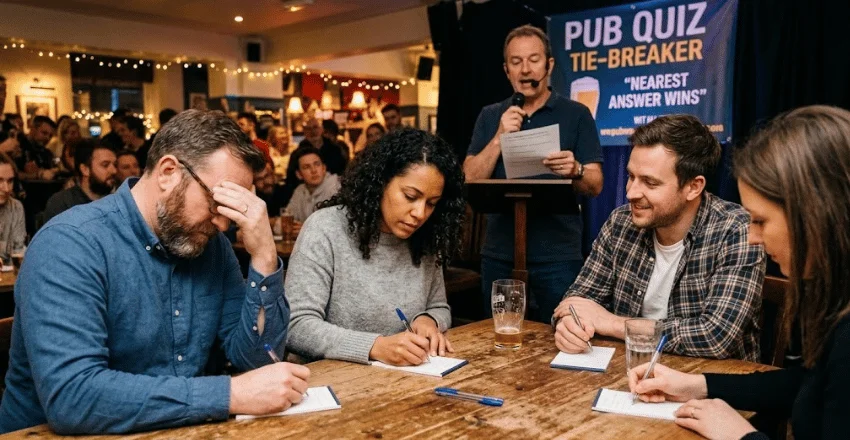
Tell teams before the question that the nearest answer wins. Ask everyone to write their guess before you collect or reveal answers. This prevents teams from adjusting their guesses after hearing another answer.
Do not automatically use a “nearest without going over” rule. That system can favour one side of the correct answer without a clear reason. Standard nearest-wins scoring treats guesses above and below the figure equally.
Prepare at least three play-off questions before the quiz begins. One can settle first place, while another handles an equal difference. The third provides a backup for another unlikely tie.
Common Mistakes Quiz Hosts Should Avoid
A factual yes-or-no question often creates another draw. Questions with several accepted figures can also start unnecessary debates. Choose figures with a clear source and precise wording.
Do not make every tie-breaker impossibly obscure. Players should have enough context to estimate a believable range. The fun comes from seeing which team gets closest, not from producing random guesses.
Also avoid using an outdated statistic without a date. Stadium capacities, records, and population figures can change. Check changing answers shortly before your quiz begins.
Frequently Asked Questions
What are tie breaker questions?
Tie-breaker questions are deciding questions used when two or more quiz teams finish with the same score. Numerical questions are popular because the closest guess can win. This usually settles the result without another full quiz round.
Should a quiz tie-breaker always be numerical?
It does not have to be numerical, but numbers make judging much easier. A closest-answer format produces more possible results than a normal right-or-wrong question. That makes another draw less likely.
What happens if two teams are equally close?
Use another prepared question rather than changing the scoring rule after answers are submitted. Keep two or three backups for this reason. A second play-off usually produces a clear winner.
Can these questions be used for family and work quizzes?
Yes, but match the difficulty to the audience. General numbers, entertainment and familiar UK facts work well for mixed groups. Harder science or sports statistics suit experienced quiz teams.
How many tie-breakers should a quiz host prepare?
Three is a sensible minimum for most events. The first settles the main draw, while the others cover repeat ties or extra prizes. Keeping backups also means you never need to invent a question under pressure.
Final Tips for Quiz Hosts
A strong tie-breaker should feel fair to every team. Use a number that can be estimated, state the units clearly, and collect every answer before revealing the result. Those simple rules make the finish quick and easy to understand.
Keep this list available when planning your next pub, family or workplace quiz. Pick several questions before the event rather than waiting for a draw. You will be ready to crown a winner without slowing the night down.