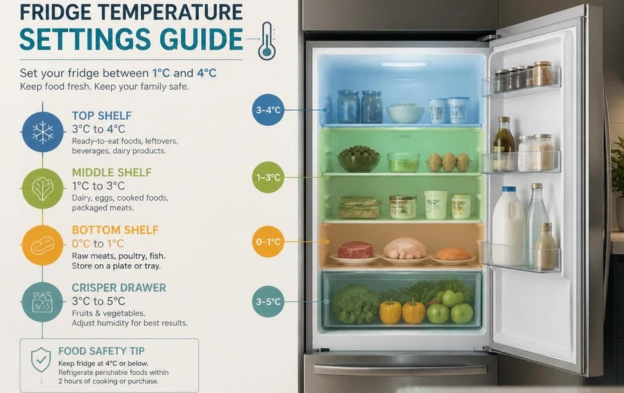
Getting your fridge temperature right is one of the simplest ways to keep everyday food safer and fresher. A fridge that runs too warm can shorten the useful life of chilled food, while an unnecessarily cold setting can freeze delicate ingredients and waste energy. For UK households, the important number to remember is 5°C or below, with the recommended operating range extending from 0°C to 5°C.
Quick answer: For UK homes, keep your fridge between 0°C and 5°C. A practical target is around 3°C to 4°C, giving you some room below the recommended upper limit without unnecessarily freezing fresh food. Keep your freezer at around -18°C, and use an appliance thermometer to verify the actual temperature.
What Temperature Should a Fridge Be in the UK?
The UK Food Standards Agency says your fridge should be between 0°C and 5°C. Setting the appliance at roughly 3°C or 4°C can be a sensible practical target because normal door opening and changes in fridge contents can cause the internal temperature to fluctuate. The key goal is to ensure the measured temperature remains within the recommended range rather than focusing on one exact number.
| Appliance | Recommended temperature | Practical target |
| Fridge | 0°C to 5°C | Around 3°C to 4°C |
| Freezer | Around -18°C | -18°C |
| Fridge above 5°C | Check and adjust. | Return to 0°C to 5°C. |
The important point is that the number displayed on a thermostat or dial does not always tell you the true temperature surrounding your food. Fridges can develop warmer and colder zones, and performance can change depending on room temperature, how much food is stored inside and how frequently the door is opened. A simple fridge thermometer therefore provides more useful information than relying on the control setting alone.
Why the Correct Setting Matters for Food Safety
Refrigeration slows the growth of microorganisms that can cause food to spoil or become unsafe, which is why proper temperature control is a basic part of food safety. Keeping chilled food at the correct temperature is particularly important for dairy products, cooked foods, salads, and other items carrying a use-by date. Correct cooling can also help food remain usable for longer, reducing unnecessary household waste.
A fridge can feel cold and appear to be operating normally while still storing food at a warmer temperature than intended. The air you feel when opening the door is not a reliable way to determine whether the whole compartment is maintaining a safe temperature. Measuring the actual temperature removes much of that uncertainty and makes it easier to notice changes in appliance performance.
What Is the Best Setting for Everyday Use?
For most UK homes, 3°C to 4°C is a useful everyday target within the recommended 0–5°C range. It leaves some margin for brief temperature increases when the door is opened while staying far enough above freezing for many fresh foods. However, the actual reading matters more than choosing one supposedly perfect thermostat number.
Temperatures are not completely uniform throughout a refrigerator, either. Different shelves and storage areas can operate at slightly different temperatures, while the door is normally exposed to greater fluctuations because it moves into the warmer room whenever the fridge is opened. That means both the thermostat setting and the way you organize the fridge affect how well different foods are stored.
If checking your fridge temperature, the fridge is part of a larger kitchen update. Scrollex’s new kitchen cost guide covers appliances, installation, cabinetry, and other renovation costs. It can help put refrigerator replacement into the context of a broader kitchen budget rather than treating the appliance as an isolated expense. That is particularly useful if an aging fridge is one of several items you are considering replacing.
Fridge Temperature Dial 1–5: Which Number Should You Use?

Many refrigerators do not display Celsius and instead use a numbered dial such as 1 to 5. On many models, 1 is toward the warmer end and 5 is toward the colder end, although the exact operation depends on the manufacturer. These numbers usually control cooling intensity rather than representing degrees Celsius, so setting the dial to 3 does not automatically mean the compartment is at 3°C.
| Dial position | Typical meaning |
| 1 | Warmer setting |
| 2 | Moderately warm |
| 3 | Common starting point |
| 4 | Colder |
| 5 | Coldest setting |
The safest approach is to treat the dial as an adjustment control rather than a thermometer. Start near the manufacturer’s recommended position, measure the real temperature inside and then make small adjustments if necessary. Always check the instructions for your particular model because dial directions, electronic controls, and recommended settings can differ between appliances.
How to Check Your Fridge Temperature Properly
You cannot reliably judge refrigerator temperature simply by touching a bottle of milk or feeling the air when you open the door. Using a suitable fridge thermometer gives you an actual reading and is especially useful with older appliances or fridges that only have a numbered control dial. Checking periodically also makes it easier to spot gradual changes before food starts spoiling unusually quickly.
To check it:
- Place a suitable fridge thermometer inside the main refrigerator compartment.
- Position it away from the door, where frequent opening causes bigger temperature changes.
- Leave the fridge closed long enough for the reading to stabilize.
- Check that the temperature remains within 0°C to 5°C.
- Adjust the thermostat slightly if needed.
- Allow the appliance time to settle before checking again.
- Continue checking periodically rather than assuming one correct reading will remain permanent.
It is particularly useful to recheck the temperature after changing the thermostat, filling the fridge with a large grocery store, or experiencing unusually warm weather. A newly loaded fridge may temporarily work harder as it cools the additional items, so an immediate reading does not always show its normal operating temperature. Look for a stable pattern rather than repeatedly turning the control after every small fluctuation.
What If Your Fridge Reads Above 5°C?
A fridge consistently reading above 5°C needs attention because it is outside the recommended household range. Start by checking that the door closes completely, the seal is clean and undamaged, internal air vents are not blocked and food is not packed so tightly that cold air cannot circulate. You can then adjust the control towards a colder setting and monitor the thermometer to see whether the temperature returns to the correct range.
Avoid changing the dial dramatically and checking again only a few minutes later. Refrigerators take time to respond to thermostat changes, and frequent door opening while testing can introduce more warm air and confuse the result. If the appliance remains too warm despite the correct settings and normal loading, consult its manual or arrange professional inspection rather than relying on an increasingly extreme dial position.
Signs a Fridge May Be Too Warm
- Milk and other chilled foods spoil unusually quickly.
- A thermometer repeatedly reads above 5°C.
- The door does not seal firmly.
- The compressor seems unable to maintain a stable temperature.
- Food feels noticeably less chilled than usual.
- Heavy ice or another fault appears to interfere with cooling.
Warm weather can make temperature control more challenging as well. Limiting unnecessary door opening helps prevent warm room air repeatedly entering the compartment and reduces the amount of heat the appliance needs to remove. A thermometer is particularly useful during hot weather because it tells you whether the fridge is actually maintaining its normal temperature.
Can a Fridge Be Too Cold?
A refrigerator temperature can also be colder than necessary, particularly if food begins freezing in areas that are intended only for chilling. Lettuce, cucumber, and other water-rich foods can suffer noticeable texture damage when they partially freeze, while drinks or dairy products may also develop ice. The problem may come from an excessively cold thermostat setting, items touching a very cold rear surface or a fault with the appliance.
Start by checking the temperature with a thermometer rather than automatically turning the control. If the compartment is below 0°C, move the setting slightly warmer and ensure food is not blocking air outlets or pressed directly against cold surfaces. Persistent freezing despite a suitable setting may indicate that the fridge needs inspection or repair.
Where Should Food Go Inside the Fridge?
Organizing a refrigerator properly can reduce the risk of cross-contamination and make better use of its different temperature zones. Raw meat, poultry, and fish should be covered and kept low down so that liquids cannot drip onto ready-to-eat food. Cooked and ready-to-eat foods can then be kept separately, while less temperature-sensitive items are generally better suited to areas that experience more variation.
| Fridge area | Suitable foods | Why |
| Upper shelves | Cooked food, leftovers, ready-to-eat items | Keeps them separate from raw meat |
| Middle shelves | Dairy and other chilled products | Convenient everyday storage |
| Bottom shelf | Covered raw meat, poultry, and fish | Helps contain accidental drips |
| Salad drawers | Fruit and vegetables suited to refrigeration | Designed for fresh produce |
| Door | Condiments and less temperature-sensitive items | Door temperature fluctuates more. |
Do not pack every shelf completely full simply because space is available. Refrigerators depend on cold air moving around their contents, and excessive loading can interfere with circulation and create inconsistent cooling. Leaving some space around food also makes it easier to organize products, see use-by dates, and avoid forgotten items at the back.
How Often Should You Check the Temperature?
Checking the temperature around once a week is an easy routine for households that use a separate thermometer. You should also make an additional check whenever you notice food spoiling unusually quickly, items unexpectedly freezing, or the appliance struggling during hot weather. A quick temperature check can identify a developing problem before it becomes obvious through wasted food.
The need for regular checking is greater when your fridge has no digital temperature display. Even appliances with a display can have warmer and cooler areas, so understanding how your own refrigerator behaves can be useful. If readings repeatedly fall outside the correct range, investigate the cause instead of treating each reading as a one-off fluctuation.
What Temperature Should a Freezer Be?
A combined fridge freezer should generally keep the refrigerator section between 0°C and 5°C and the freezer at around -18°C. These are separate targets even when both compartments belong to the same appliance, and changing one control does not always affect both sections in the same way. Check the manual if your appliance has separate digital controls or a shared thermostat system.
The freezer setting matters because freezing is intended to keep stored food at a much lower temperature than ordinary refrigeration. A freezer that is considerably warmer than its intended setting may not be operating properly, while making it unnecessarily colder can increase energy use without providing a useful everyday benefit. Monitoring both compartments is particularly sensible if you notice thawing, excessive frost, or frequent compressor operation.
Keeping the Fridge Cold During a UK Heatwave
During hot weather, your fridge has to remove heat entering from the surrounding room every time the door opens. Keeping unnecessary door opening to a minimum reduces the amount of warm air entering the compartment and can help the appliance maintain a stable internal temperature. A thermometer becomes particularly useful during very warm spells because it shows whether the refrigerator is actually coping with the conditions.
You should also avoid placing the appliance directly beside strong heat sources where the manufacturer advises against it. Check that ventilation around the refrigerator remains unobstructed and follow the installation clearances specified in its manual. If a fridge repeatedly struggles every summer, its installation, ventilation, or mechanical condition may need checking rather than simply running it permanently on the maximum setting.
What Happens to Fridge Food During a Power Cut?
Keeping the refrigerator door closed is one of the most useful things you can do during a power cut because opening it releases stored cold air. The actual temperature inside the appliance and the duration of the outage matter more than simply knowing that the electricity has failed. A fridge thermometer can therefore help you understand how quickly the compartment is warming.
Be particularly cautious if you do not know how warm the appliance became or how long perishable food spent outside normal refrigeration temperatures. Smell and appearance alone cannot establish that potentially hazardous food is safe, so uncertainty should be treated cautiously. People who are more vulnerable to foodborne illness should take particular care with chilled ready-to-eat foods after a prolonged loss of refrigeration.
Does a Colder Fridge Use More Electricity?
Setting a refrigerator unnecessarily cold can make the appliance work harder because it must remove additional heat to maintain the lower target. The exact difference depends on the fridge, its efficiency, room temperature, ventilation, and household habits, so there is no single saving that applies to every model. The sensible goal is therefore not to make the fridge as cold as possible but to keep it reliably within the correct operating range.
Everyday behavior can make a difference as well. Avoid holding the door open, allow air to circulate inside and make sure the door seals close properly so the appliance is not constantly replacing lost cold air. These small habits can support both temperature stability and efficient appliance operation.
If you are comparing other frequently used kitchen appliances, the Scrollex Best Kettle UK Guide looks at performance, features, and everyday energy considerations. That can be useful when you are reviewing several appliances rather than focusing only on refrigeration. Taking a whole-kitchen view can make it easier to prioritize upgrades according to condition, usage, and budget.
Common Cooling Problems and Quick Fixes
Temperature problems are often caused by relatively simple issues before they are caused by a major appliance failure. Checking the setting, thermometer reading, door seal, and internal loading gives you a useful first diagnosis without dismantling anything. If basic adjustments do not restore a stable 0–5°C temperature, use the manufacturer’s troubleshooting guidance or contact a qualified repair professional.
| Problem | What to check first |
| Fridge above 5°C | Thermostat, door seal, loading, and ventilation |
| Food freezing | Setting too cold, cold spots, and food position |
| Temperature keeps changing. | Frequent opening, warm room, or unstable thermostat |
| The fridge runs constantly. | Door seal, ventilation, temperature setting, or fault |
| Fridge warm after a large food shop | Allow time for newly added food to cool. |
| Display and thermometer disagree. | Verify with another suitable thermometer and manual. |
Final Thoughts
The correct fridge temperature for UK homes is straightforward: keep the appliance between 0°C and 5°C, with roughly 3°C to 4°C providing a useful everyday target for many households. Rather than relying only on the thermostat dial, use a fridge thermometer, check it regularly, and pay attention when food starts spoiling or freezing unexpectedly. A correctly set and sensibly organized refrigerator supports food safety, reduces avoidable waste, and helps the appliance do its job without unnecessary cooling.
FAQs
Is 5°C Cold Enough for a Fridge?
Yes, 5°C is at the upper end of the recommended UK household refrigerator range. Because temperature can rise temporarily when the door opens, some households may choose a practical target closer to 3°C or 4°C. The important requirement is that the measured temperature stays within 0°C to 5°C rather than simply trusting the thermostat display.
Is 1 or 5 colder in a fridge?
On many manual 1–5 fridge controls, 5 is the colder setting and 1 is the warmer setting. The numbers normally indicate cooling intensity rather than actual degrees Celsius, so a setting of 3 does not mean the compartment is necessarily at 3°C. Check the instructions for your exact appliance and confirm the result with a thermometer because control systems can vary.
Is 7°C Too Warm for a Home Fridge?
Yes, 7°C is warmer than the recommended 0–5°C range for a household fridge. If your thermometer repeatedly reads 7°C, adjust the appliance to be colder and check common causes such as poor door sealing, blocked airflow, or excessive loading. If the temperature will not fall after appropriate adjustment, consult the appliance instructions or arrange repair.
Where Is the Coldest Part of a Fridge?
The lower part of many conventional refrigerators can be colder than some upper areas, although the exact temperature pattern varies according to appliance design. Keeping covered raw meat and fish low down also helps prevent accidental drips from contaminating foods underneath. Do not assume every refrigerator has identical cold spots, particularly if yours uses fan-assisted or multi-airflow cooling.
Should I Change My Fridge Setting in Summer?
You may need to adjust the setting if a thermometer shows that the fridge is no longer maintaining the correct temperature during warmer conditions. Do not change it simply because the calendar says it is summer, because a properly functioning appliance may maintain the right temperature without adjustment. Measure first, make a small change if necessary and follow the manufacturer’s instructions for your particular fridge.