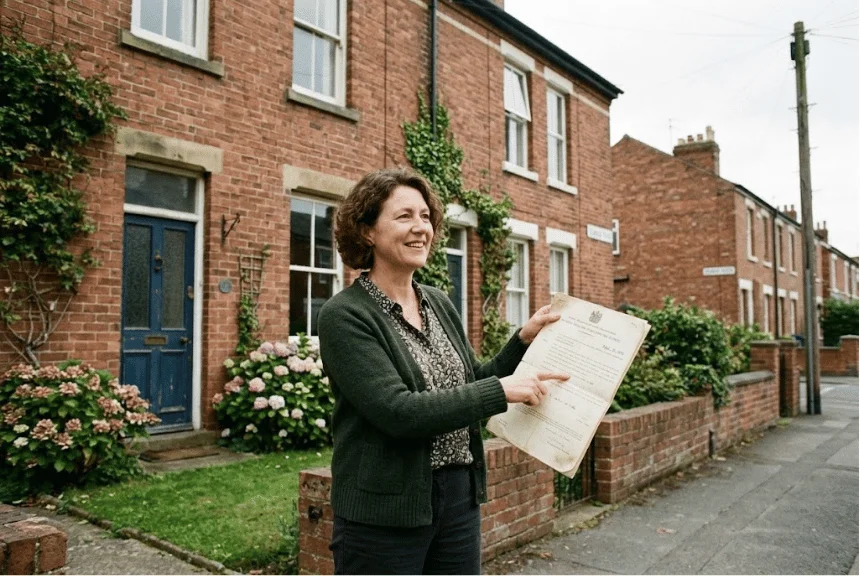
Finding your home’s age can help with insurance, renovations, surveys, and simple curiosity. If you’re asking when was my house built, start with its Energy Performance Certificate, which may show a construction age band. You can then narrow the date using deeds, historic maps, council records, and other evidence.
Quick answer: Check your property’s EPC first because it may show a construction age band. For a more precise date, compare title deeds, HM Land Registry information, historic Ordnance Survey maps, local archives, and council records. Newer properties may also have planning applications or building-control documents that identify their construction period.
| Method | What it can tell you | Best for |
|---|---|---|
| Energy Performance Certificate | Approximate construction period | Fast first check |
| Title deeds | Ownership history and sometimes early conveyances | Narrowing the date |
| HM Land Registry | Registration, ownership and historical title information | England and Wales |
| Historic maps | When a building first appears on a site | Older properties |
| Local archives | Plans, maps, directories and estate papers | Detailed research |
| Planning records | Applications and development dates | Newer properties |
| Census and directories | When an address became occupied | Older homes |
| Building features | Likely architectural period | Supporting other evidence |
How to Find When Was My House Built Records
No single UK database reliably gives an exact construction year for every home. Older properties often require evidence from several sources before you can establish a convincing date. Start with quick digital checks before moving into historical records.
The process also varies across the UK. HM Land Registry covers England and Wales, while Scotland and Northern Ireland use different land-registration systems. Knowing which records apply to your location will save time.
For older buildings, think about narrowing a date range. One record might prove the house existed by 1901, while an earlier map shows an empty plot. Together, those records can provide a useful construction window.
1. Check the Energy Performance Certificate
An Energy Performance Certificate is often the fastest starting point in England, Wales, and Northern Ireland. The government EPC service lets you search using a postcode, street, town, or certificate number. Scotland has a separate certificate service.
An EPC may record the property’s construction age as a period rather than one specific year. For example, the assessment could place a home within a band covering several decades. This makes an EPC useful for establishing the likely era.
Treat that age band as an estimate, not definitive proof. An assessor’s recorded period does not replace original construction documents. Extensions and major alterations can also complicate a building’s apparent age.
2. Look at Your Title Deeds
Old title deeds can provide valuable clues about a property’s origins. Conveyances may mention previous owners, developers, plots, estates, or transactions connected with the original building. Your solicitor, mortgage provider, or personal records may contain relevant documents.
Don’t assume the earliest date on a deed is automatically the construction date. Land can change ownership before anyone builds a house on it. A dated document should therefore be considered alongside maps or other records.
HM Land Registry does not keep every original paper deed. For registered properties, its records may state whether particular filed deeds are available. Older paperwork may instead be held by previous owners, solicitors, or local archives.
3. Search HM Land Registry Records in England and Wales
HM Land Registry provides information about registered property in England and Wales. You can search for a property summary and obtain its title register or title plan. Historical title registers can sometimes help when researching a property’s age.
A registration date should not automatically be treated as a building date. A house could have existed for decades before its title entered the modern registration system. The register works best as one piece of a larger evidence trail.
Historical ownership information can still narrow your search. References to earlier transfers, leases, covenants, or filed documents may point towards useful evidence. Follow those references before concluding the construction year.
4. Compare Historic Ordnance Survey Maps
Historic maps are especially useful when documentary records do not state a construction date. Compare maps from different periods and identify when a building first appears on the plot. This can establish a practical date range.
Suppose an 1885 map shows an empty plot, while an 1898 edition shows your terrace. You then know construction probably occurred between those mapping dates. Directories, deeds, or building plans may narrow that period further.
Historic England notes that Ordnance Survey maps from the nineteenth century onwards can help establish when houses appeared. Local record offices and university libraries may hold relevant editions. Digitised historical mapping can make the comparison much faster.
5. Search Your Local Archive
The National Archives recommends starting locally when researching a house’s construction and ownership history. County, borough, and city archives can contain maps, estate papers, electoral registers, and other useful records. Local studies libraries may hold similar collections.
Building plans can be particularly valuable for properties dating from the mid-nineteenth century onwards. Surviving plans may identify an owner, architect, developer, proposed layout, or application date. Availability varies widely between local authorities.
Search beyond your current street address. Road names and house numbers can change over time, while individual homes may once have had names. Estate names, former owners, and nearby landmarks can reveal records that address searches miss.
6. Check Planning and Building-Control Records
Planning records can provide strong evidence for modern houses and later developments. Search your local authority’s planning portal using the address, postcode, or surrounding development. Original applications may identify when a site was approved for housing.
Building-control records can also help, particularly where completion information survives. These records may distinguish the original property from later extensions, loft conversions, or structural alterations. That distinction matters when several parts of a home were built at different times.
Older properties are less likely to have useful online planning records. Local archives may hold documents that never made it into a modern digital system. Contact the council or archive if the online search ends before the likely construction period.
7. Use Census Records, Directories and the 1939 Register
Occupancy records can help determine whether a house existed by a particular date. The National Archives highlights census records, the 1939 Register, electoral material, and local records as useful house-history sources. These records are especially helpful after you have estimated a likely decade.
An address appearing in a directory proves occupation, not necessarily construction that year. The building could have been completed earlier and remained empty or recorded differently. Use occupancy evidence alongside maps and deeds.
Street renumbering creates another potential problem. Check neighbouring properties, household names, occupations, and old maps before assuming two similar addresses refer to the same building. This extra check can prevent a false construction date.
8. Read the Architecture for Clues
The building itself can help you estimate an era before you begin documentary research. Window proportions, roof shape, brickwork, floor plans, original fireplaces, decorative details, and construction methods often reflect particular periods. These features work best as supporting evidence.
A Victorian-looking frontage does not prove a Victorian construction date. Owners frequently replace windows, add extensions, remodel entrances, and copy older architectural styles. Some buildings also incorporate structures from more than one period.
Use architectural clues to guide your document search rather than settle it. If the building appears late Victorian, for example, compare maps and directories around that period. Documentary evidence can then confirm or challenge your visual estimate.
What If You Live in Scotland?
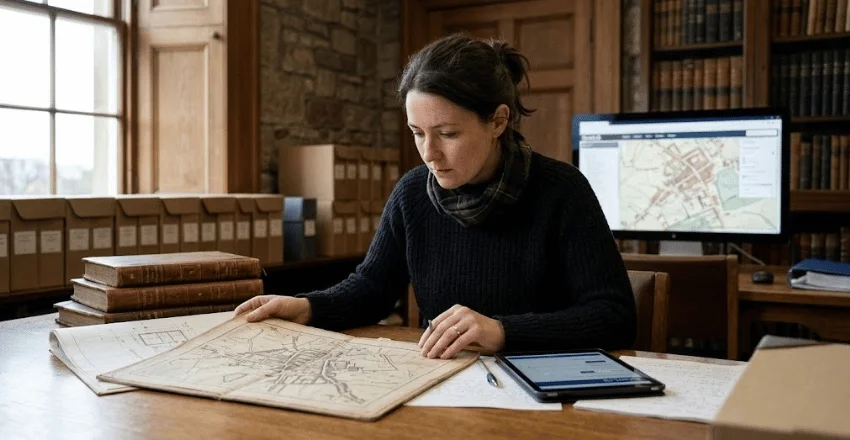
Property records work differently in Scotland. Registers of Scotland manages the Land Register and the older General Register of Sasines. ScotLIS allows public searches for property information and registered titles.
Registers of Scotland specifically states that it does not hold information showing when a property was built. Its records can still provide ownership and deed evidence that supports historical research. Older Sasine records can provide chronological information about transactions affecting a property.
Historic maps and local archives therefore remain useful for Scottish homes. The National Library of Scotland provides extensive digitised historic mapping covering Scotland, England, and Wales. Comparing editions can show when a building first appeared.
Why Does Your House’s Age Matter?
Home insurers may ask for an approximate construction year when preparing a quote. Age can also help a surveyor understand which materials and building techniques may be present. That knowledge can guide further investigation without proving the property’s condition.
Renovation decisions can also depend on construction methods. An older solid-wall property may require a different approach from a later cavity-wall house. Base alterations on the building’s actual materials and condition.
Age can also add context when buying or selling a home. Buyers may want to understand its history, previous changes, and likely maintenance needs. Reliable records are more useful than an unsupported date copied from an old listing.
How to Get the Most Accurate Answer
Start with the EPC because it offers the quickest indication for many properties. Then compare at least two independent historical sources before accepting an exact year. Maps, deeds, planning documents, and archive material are stronger when they support each other.
Create a simple timeline while researching. Record the earliest source showing the building and the latest source showing the plot before construction. Add dated deeds, directories, photographs, and council records between those points.
Avoid turning an approximate period into a precise year without evidence. If all you can prove is that construction occurred between 1895 and 1900, keep that range. A defensible range is more useful than an invented date.
Frequently Asked Questions
When was my house built if I cannot find the exact year?
Start by finding the property’s likely construction period through its EPC or architectural features. Then compare historic maps, deeds, directories, and local records to narrow the range. Older UK homes often have an approximate date rather than one documented construction year.
Does HM Land Registry tell you when a house was built?
Not necessarily. HM Land Registry records ownership and registered interests in property across England and Wales, but registration doesn’t equal construction. Historical registers and filed deeds can still provide useful clues.
Can an EPC tell me the exact age of my house?
An EPC commonly provides a construction age band rather than an exact year. That makes it useful for quickly identifying the likely period. Use documentary records if you need stronger evidence for a specific year.
How can I find the age of a Victorian house?
Begin with historic Ordnance Survey maps and local archives. Census records, directories, old photographs, estate papers, and deeds can then narrow the date. Architectural features can support your findings but should not be your only evidence.
What is the best way to find an exact construction date?
Original building plans, developer documents, early conveyances, or council records can provide the strongest evidence. If those records do not survive, compare several independent historical sources. A narrow date range may be the most accurate result you can find.
Start Building Your House Timeline
You don’t need to research every archive at once. Begin with the EPC, then check property documents and historic maps. Those three sources may narrow the construction period enough for most practical purposes.
If the date remains unclear, move into local archives, planning files, directories, and occupancy records. Keep copies of the evidence and record where each date came from. You will finish with a house history you can explain and verify.